How to survive a Pokémon Center queue — the UK collector's playbook
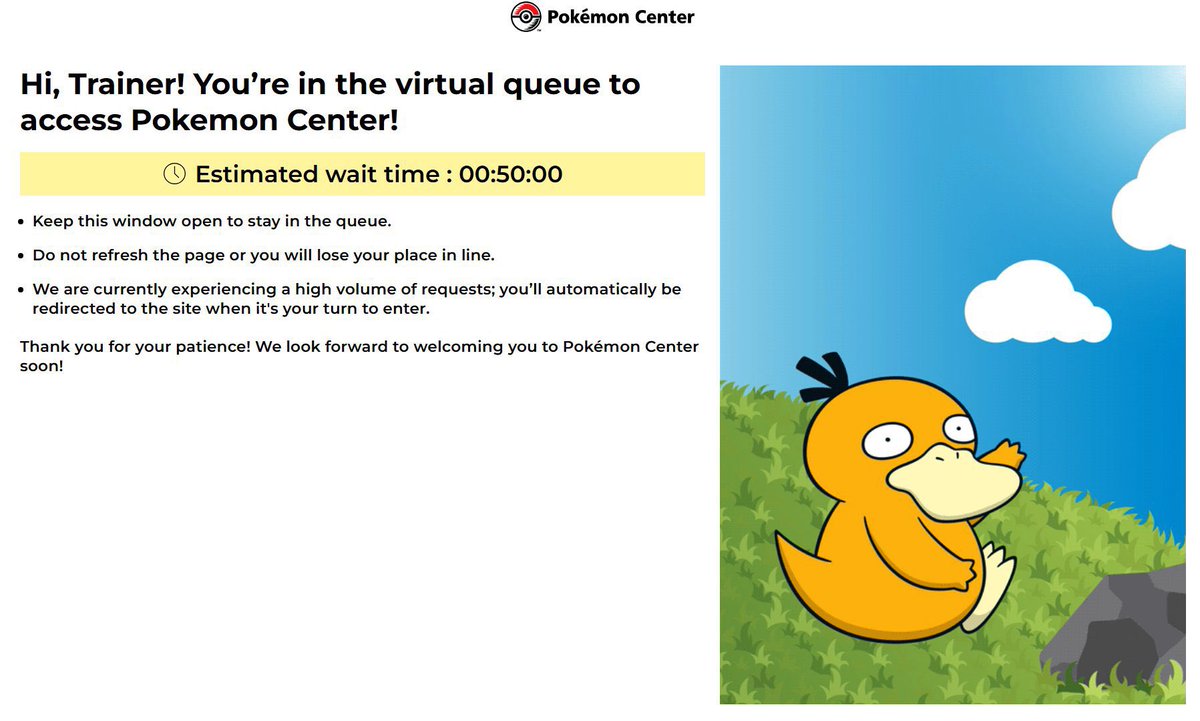
A postman Pikachu waves you into a virtual waiting room, or a Psyduck sits in the grass beside a fifty-minute timer. Either way a drop is live, and the next hour decides whether you land an Elite Trainer Box at RRP or watch it vanish. Here is how not to fumble it.
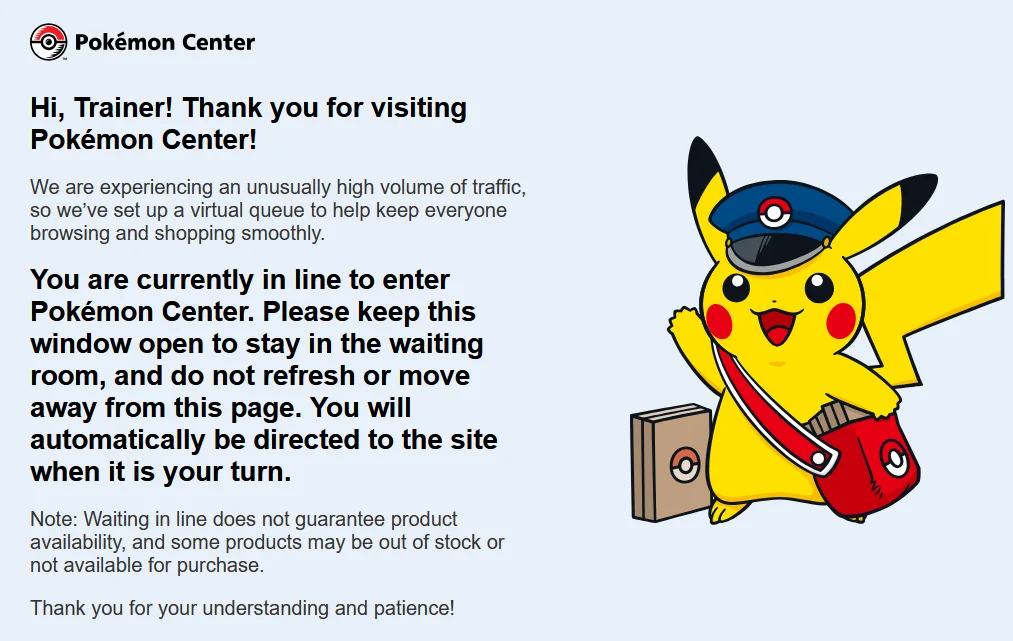
You refreshed pokemoncenter.com on a hunch, and there he is: Pikachu in a postman's cap, satchel over one shoulder, waving you into a virtual waiting room. Or it is Psyduck, sitting blankly in the grass next to an "estimated wait time" of fifty minutes. Either character means the same thing — a drop is live, you are in line, and what you do over the next hour decides whether you walk away with sealed product at RRP or refresh your way to the back of a queue a million people deep.
Pokémon Center drops are the most stressful fifteen minutes in UK collecting, mostly because almost nobody arrives prepared. The same questions get asked every single time, in real time, while the window is closing. This is the playbook — what the queue actually is, how to read the run-up, and the small number of things that genuinely change your odds.
First, understand what you are looking at
The queue is a virtual waiting room the site throws up when traffic spikes past what it wants to let in at once. It is not personal, it is not broken, and — critically — it is not refreshable. You are issued a place in line, the page holds it, and when it is your turn you are passed through to the store automatically.
The detail that catches UK collectors out: pokemoncenter.com is effectively one storefront with regional front-ends, and the queue is shared across them. The drop you are waiting on might be US-only, or the UK allocation might be a different set of items entirely. This matters more than it sounds — clicking a US product link from a UK connection is one of the quickest ways to get your IP temporarily blocked before you have bought anything.
Knowing when it is coming (you mostly cannot)
Here is the uncomfortable truth: nobody can predict a Pokémon Center drop with certainty. What experienced collectors watch for is a "security change" on the site — a quiet back-end tweak that frequently precedes a drop by anything from minutes to a few hours. Treat it as an early-warning flare, not a promise. Sometimes the change is just maintenance and nothing drops at all. But it is a strong enough signal that you do not want to ignore it.
As for patterns: historically most UK drops have landed on a Tuesday or Wednesday, roughly between 4pm and 7pm UK time. Useful as a tendency, dangerous as a timetable — drops have happened on other days and well outside that window. The only assumption that has never let anyone down is that it will go live the one afternoon you stepped away from your desk.
The one rule that matters: do not refresh
Once the postman Pikachu has you in line, the single fastest way to throw away your place is to hit refresh. A manual refresh drops you to the back of the queue. The page does its own small automatic refresh on a timer to update itself — that is completely normal and does not reset your position. Leave it alone and let it work.
While you wait: do not navigate away, do not let the device fall asleep, do not open the product in a second tab, and do not open the developer-tools inspector once you are near the front. The site is jumpy, and any of those can boot you out or trip a bot flag that sends you back to square one. If you run a browser extension that auto-refreshes pages, disable it before you join.
When the gates open: get in clean
When you are let through, go to the homepage first — pokemoncenter.com — not a deep link someone pasted into a chat. Early or wrong-region links are the classic way to get IP-blocked at the worst possible moment. From the homepage, head to New Releases → TCG for a fresh set, or use search if it is a restock of something that already exists.
Browser choice matters more than you would expect. Collectors have reported Edge as the most reliable lately, with Chrome throwing more errors than it used to, and Safari and Opera somewhere in between. Any of them can work — but if you have a choice, lean on the one with the best recent track record. Watch the per-order limits too: new releases are usually capped at one per order, restocks sometimes two. The product page will tell you, or it simply will not let you over-add.
Check out at grandma speed
This is the counterintuitive part, and the one people refuse to believe until it costs them an order. Once you are through the queue, slow right down. On a major launch the stock is not going to evaporate in the ninety seconds it takes you to check out calmly — but moving too fast absolutely will cost you the order. Autofilling your address and card details and then clicking straight through reads as automated behaviour, and the site answers it with an error.
So fill each field at a human — frankly, elderly — pace, and pause for a breath before you advance to the payment step. Logging in gives you no priority whatsoever over guest checkout, so use whichever you trust. The order will not sell out from under you while you are being careful. It will sell out if you panic.
Payments: Pokémon Center’s weak spot
Pokémon Center’s checkout is notoriously fussy about cards, and this is where well-prepared orders still die. American Express and cards without a verification step frequently just fail outright. Your best odds come from a card whose billing address matches your shipping address and that supports a 3-D Secure verification step — or PayPal, which is solid but has its own occasional wobbles. Keep your first address line short, too: overly long first lines have been reported to break checkout entirely.
Decoding the error codes
Two error codes show up more than any others, and knowing the difference saves you a panic:
Error 15 means your browser session is blocked. Refresh, clear your cookies and cache, switch to a different browser, or drop into an incognito window. Error 17 means your IP address is blocked, usually for around an hour — and switching devices on the same Wi-Fi will not help, because they all share that one blocked connection. The fastest fix is to jump onto mobile data, toggling airplane mode on and off to grab a fresh IP; restarting your router is a last resort because it takes too long. iPhone users on iCloud+ should turn off Private Relay, which quietly interferes with the whole process.
And the tempting shortcut that is not one: a VPN. Pokémon Center tends to answer VPN traffic with a flat "Something went wrong," so it usually makes things worse, not better. For any error that is not a 15 or a 17, a refresh is worth a try — just accept that it may put you back in the queue.
Do not panic at the number
Your position can read 600,000, or comfortably past a million on a marquee launch, and it is not the death sentence it looks like. A huge share of any queue errors out, gets bot-flagged, or simply wanders off, and the line moves a good deal faster than the raw figure suggests once it gets going. First-wave Mega-era launches in particular have been enormous and run for a couple of hours. The collectors who give up at the sight of a big number are a meaningful chunk of the reason the people who stay get through.
Pre-orders: read this before you panic about your money
Pokémon Center pre-orders behave in ways that look broken but are not. Payment is typically taken as an authorisation hold around a week before dispatch, then often released back to you, then charged properly when the item actually ships. A refund quietly landing in your account does not mean your order was cancelled — it is just the hold being released. Set pre-orders usually dispatch about two days before the public release date, timed so they arrive on or just before launch.
A couple of smaller reassurances: if you look up a guest order and it does not show your full name or first line of address, that is normal — the confirmation and dispatch emails carry the complete details. And pre-order windows have opened anywhere from a week to two months ahead of release, so never assume you have time to think it over.
Early Access: the way that skips the queue entirely
There is one route that sidesteps the whole waiting-room circus, and it is officially run by Pokémon Center: the Early Access programme. It lets selected customers buy popular items — including pre-orders — before they go to wider release. No million-deep queue, no postman Pikachu. The catch is that you do not choose to join it; it chooses you.
Eligibility is tied to the Pokémon Center newsletter. Subscribers who meet certain criteria may be selected — and Pokémon Center deliberately does not publish what those criteria are. The programme currently runs only in the United States, Canada and the United Kingdom, so UK collectors are squarely in scope. You do not need an existing account to be invited, but you do need to log in or register with the exact email address the invitation was sent to before you can check out.
If you are picked, you receive an email with a unique invitation link. That link is single-use, non-transferable, and tied to your email — and Pokémon Center is explicit that it can be disabled if it suspects misuse. Trying to game the system by holding multiple newsletter subscriptions or signing up under several email addresses does not improve your odds and can void the invitation outright. When an invite does land, treat it as perishable: it carries an expiry date, stock is limited and sells out, and the official advice is to use it sooner rather than later. Open the link on a single device and browser — juggling several can break the order.
The honest framing: Early Access is not something you can farm. The best you can do is be a genuine, single-account newsletter subscriber and hope your name comes up. But for a UK collector it is free to enter and occasionally turns a frantic queue morning into a calm two-minute checkout — so it is worth being subscribed before the next big set lands.
The mindset that actually wins
The hardest skill in all of this is not technical — it is refusing to overpay. Every Pokémon Center Elite Trainer Box in living memory has restocked, frequently more than once. The genuine catch is that PC Elite Trainer Boxes are a store exclusive, so the website is the only place to get them at RRP at all — which is precisely why learning the queue is worth the effort, and why scalper markups on them are a trap rather than a necessity.
You also do not need to pay anyone for the privilege. Free collector communities flag the moment a queue is detected and share the very same signal that paid services charge twenty pounds a month to relay. Set your alerts, keep a tab parked on the homepage, check out like you have all the time in the world — and let the postman Pikachu come to you.