Why the Japanese Mega Brave SAR still trades at a premium to its English counterpart
Print runs, paper stock, holo pattern — the structural differences between JP and EN copies of the same illustration are real, and they explain a price gap that most resellers misprice.
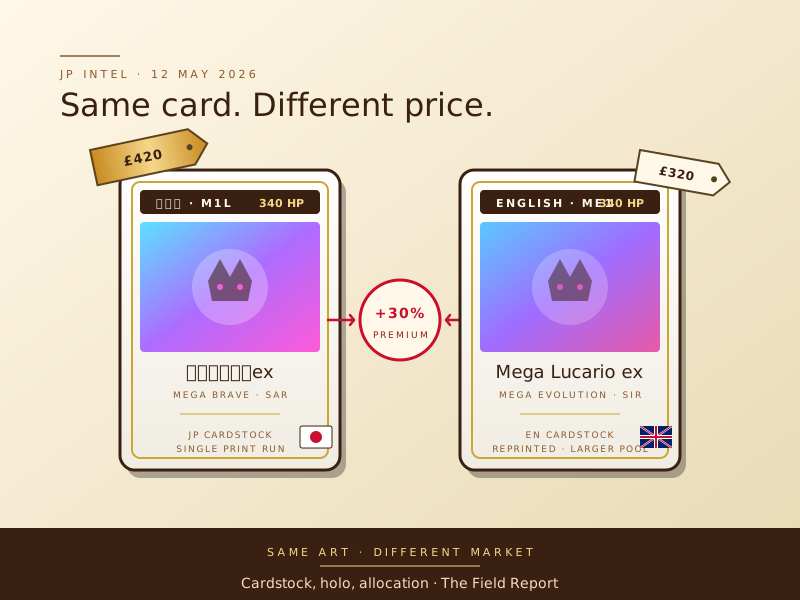
Mega Brave (M1L) and its sister set Mega Symphonia (M1S) launched simultaneously in Japan on 1 August 2025, with the combined English edition Mega Evolution (ME1) following on 26 September 2025. The Mega Lucario ex SAR from M1L — illustration by Atsushi Furusawa, depicting Lucario in a stone arena with aura energy erupting in a circular shockwave — is the chase pull that defined the early Mega era for many collectors.
Several months after EN release, the JP version of this card continues to trade at a meaningful premium over the EN version on Cardmarket and Yahoo Auctions Japan. The premium has narrowed from its post-launch peaks but remains visible on the live price snapshots we track.
The premium is real, it is structurally explainable, and it is a useful lens through which to evaluate every dual-printed JP/EN chase card going forward.
The three structural differences
First, paper stock. JP and EN print on different cardstock weights and finishes. JP cardstock is thinner — a noticeable difference in hand — and uses a slightly different paper fibre that takes the foil layer differently. Collectors who own raw copies of both consistently describe the JP card as "lighter" and "snappier"; whether that translates to a gradeable difference at the PSA level is debated.
Second, holo pattern. The JP printing process applies the holographic foil layer with a different scatter pattern than the EN process. On the Mega Lucario SAR specifically, this is visually significant: the JP holo gives the steel-type spikes a more pronounced iridescence, particularly in the cooler colour range. EN copies are not dimmer — the pattern is simply different, and many collectors prefer the JP rendering.
Third, allocation. JP print runs for Mega era sets have generally been smaller per-population than EN print runs. JP TCG sets are designed for a domestic market that is large but bounded, while EN sets serve a global English-language market that includes North America, the UK, Australia, and significant secondary distribution into Asia. EN sets therefore receive larger allocations, more reprints, and broader supply.
The factor most resellers miss
The component that consistently catches resellers off-guard is the long-tail nature of the JP allocation, not just its size at launch.
EN Mega Evolution sets are reprinted into the channel through their first year-plus. JP sets typically receive a single initial allocation and are not reprinted at the same cadence. Several months after launch, sealed JP Mega Brave is genuinely scarce in Japan and rarely available at MSRP through retail channels. EN Mega Evolution sealed product is still being restocked at Pokémon Center UK and elsewhere as of this writing.
This asymmetry compounds. The JP card pool gets smaller as a percentage of the global supply over time, not larger.
What the premium should be
A reasonable structural premium for JP over EN on Mega era chases — accounting for the three factors above and the long-tail allocation differential — should be visible but not extreme. Use the live JP/EN price ratio on our set pages as the most current reference rather than any number we could write here.
Cards where the JP/EN gap has narrowed sharply are typically signalling weaker demand for the specific illustration, not weaker structural value. Cards where the JP premium has expanded sharply post-launch are signalling speculation, not structural appreciation. Both are useful market signals.
For UK collectors deciding whether to import JP or buy EN: the JP version is the better hold if you intend to keep the card raw and unmodified over the long term. The EN version is the better buy if you intend to grade — both can be cross-graded, but the larger EN sample size makes PSA 10 outcomes marginally more accessible and resale liquidity meaningfully higher.
The premium is real. Pay it for the right reasons.